
Silencing Local Voices Opposing the Myitsone Project
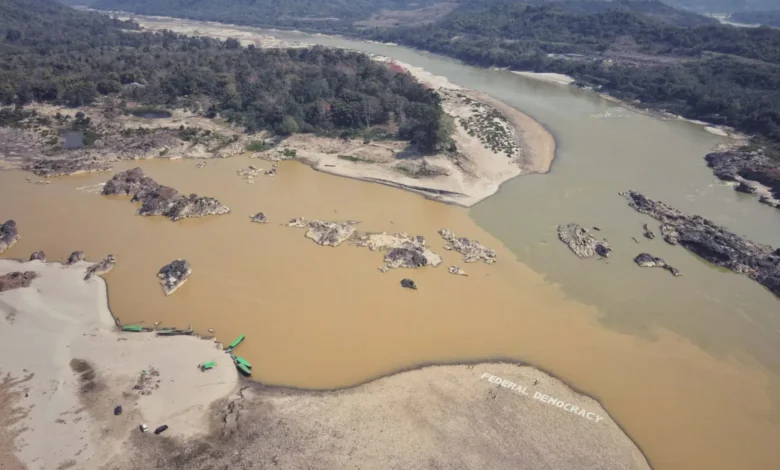
A local resident expressed a desire to speak out, but he was hesitant due to serious security concerns.
Throughout the conversation, he spoke in a lowered voice, carefully choosing each word. “People are worried about the Myitsone project, but no one dares to speak anymore. Even if there are events, they don’t attend. They are warned that they could be arrested or threatened. No one will protect them,” said one local resident.
Although many people still oppose the Myitsone project, local voices have been silenced.
Public concerns about the project have not disappeared, however, the voices of those who have opposed it for years are gradually fading.
One key reason is that people are now prioritizing their personal safety.
Due to instability in the region and warnings from the military junta that anyone opposing projects could face legal action, locals fear imminent arrest. As a result, they have begun to restrict their own freedom of expression and they self-censor.
According to data from the AAPP, nearly 8,000 civilians have been killed since the coup, due to opposing the military junta.
Additionally, limited job opportunities have pushed many residents to rely more heavily on extractive industries, such as gold mining.
Struggling for their daily survival, many people fear that opposing the Myitsone project could jeopardize their livelihoods.
The project, once halted by strong public resistance, is now showing signs of resuming–—but unlike the past- the public’s opposition is not visible.
According to local sources, individuals linked to the project have reappeared in villages where residents were previously displaced by the dam.
“Their people are constantly present in the village. During the conflict, they only withdrew temporarily… now in 2026, they seem to be active again,” said an anonymous resident.
Reportedly, employees of theState Power Investment Corporation (SPIC, formerly CPI) are still present in these communities, providing rice and basic supplies to elderly residents and students, and offering awards at school events.
However, locals say there has been no direct engagement with those most affected—particularly displaced communities.
“If People Are Threatened First, Who Would Dare Speak Out?” Concerns Over the Freedom of Public Consultations
The Myitsone project had been suspended for over 14 years due to public opposition. But nearly five years after the coup, the military junta is now making renewed efforts to resume operations.
Public consultation meetings which are held frequently in Myitkyina Township are the most visible signs of the junta’s efforts to resume operations.
These meetings have included junta-appointed union ministers, local committee members, experts, businesspeople, community leaders, students, and representatives from social organizations.
Officials—including State Chief Minister U Khet Htein Nan and Daw Dwe Bu, a member of the junta’s advisory body—have spoken in support of the project, emphasizing its potential benefits.
Notably, both individuals had previously opposed the Myitsone dam but have since shifted their positions after the coup, reflecting how political and economic incentives can reshape attitudes toward the project.
On December 16, 2025, the military junta issued a statement warning that anyone opposing the projectwithout “solid evidence” would face legal action.
This has raised serious questions about whether public consultations can truly be considered ‘free and meaningful’.
Hpauna Seng Hkum, studying natural resource management in the United States highlighted the importance of Free, Prior, and Informed Consent (FPIC), emphasizing that people must be able to express their views without coercion or threat.
“If people are threatened with arrest or punishment first, then when they’re asked to share their opinion—who would dare answer? That’s not ‘free,’” he said.
On April 1, 2026, the Kachin State Human Rights Defenders Network issued a statement strongly condemning attempts to restart the Myitsone dam project.
The group noted that successive governments from 2010 to 2020 had suspended the project following strong opposition from local communitiesacross Myanmar, and the international community due to potentially adverse social and environmental impacts.
It emphasized that the current period—marked by nationwide armed conflict—is not a time when genuine public consent can be obtained.
The network stated that moving forward with the project during this period of severe political instability disregards the voices of the general public, as well as domestic and international environmental experts.
“Development or Risk?”
Former Junta Deputy Leader Soe Win stated that the dam could be re-designed with a lower heightto withstand earthquakes.
Authorities also claim the project could meet national electricity demand and even support industrial development.
During public consultations, junta representatives have pointed to international examples where dam construction contributed to economic growth, in an effort to garner public support.
However, environmental experts warn that concernshave not been adequately addressed. . “Actual construction of large dams often differs from initial calculations, and a project like this could severely impact the Irrawaddy River,” said environmental activist U Zung Ting.
He added: “Building the Myitsone dam is equivalent to killing the Irrawaddy River—and killing the Irrawaddy is like killing Myanmar.”
Experts also note that the project site lies only about 18 miles from the Sagaing Fault, significantly raising risks of flooding in the event of an earthquake.
Opponents warn that the dam could flood an area nearly the size of Singapore.
“Myitsone and Concerns Over Sovereignty”
The Myitsone project is located about 23 miles north of Myitkyina and was initiated in 2009 through a joint venture between the State Power Investment Corporation (SPIC, formerly CPI), the Myanmar government, and Asia World Company.
It is part of a larger hydropower scheme involving seven dams along the Mali and N’Mai rivers.
The Myitsone dam alone is expected to generate 6,000 megawatts of electricity.
According to available data, SPIC holds 80% ownership, the Myanmar military government holds 15%, and Asia World holds 5%. China is expected to finance the entire project. Additionally, about 90% of the electricity generated would be exported to China, leaving only 10% for Myanmar.
Despite these factors, the junta continues to claim that the project would ensure nationwide electricity sufficiency. Profit-sharing estimates suggest 70% to China, 20% to Myanmar, and 10% to Asia World.
However, the detailed stipulations of the contract have not been publicly disclosed, raising concerns about transparency.
“The contract with China should be made public and reconsidered. We need to question why such a large share goes to China,” said Seng Hkum.
He also suggested that renewed efforts to restart the project may be linked to broader political and geopolitical negotiations.
Large-scale dam construction, he warned, is not only about energy—but also about power, control, and geopolitics.
“If so many projects are built, these areas could effectively become controlled by China. It would be like gas pipelines—we can’t even touch them. This reflects a strategic approach by the military,” Seng Hkum said.
While the Myitsone project promises economic benefits and electricity generation, the growing silence of local communities raises deeper questions about its legitimacy.
The Kachin Independence Organization (KIO) has not issued an official statement but emphasized that public opinion remains central. “We rely on the people. If the people do not accept it, we will not accept it,” said a KIO spokesperson, Colonel Naw Bu.
Ultimately, the Myitsone project is not just about energy or development. It sits at the intersection of public will, political power, environmental risk, and national sovereignty—issues that demand careful and transparent consideration.
